Othello D. Gomes
Graduate Student in Physics at University of Cincinnati
Research Interests & Experiences
PicoCal: R&D for LHCb's ECAL Upgrades Ib and II
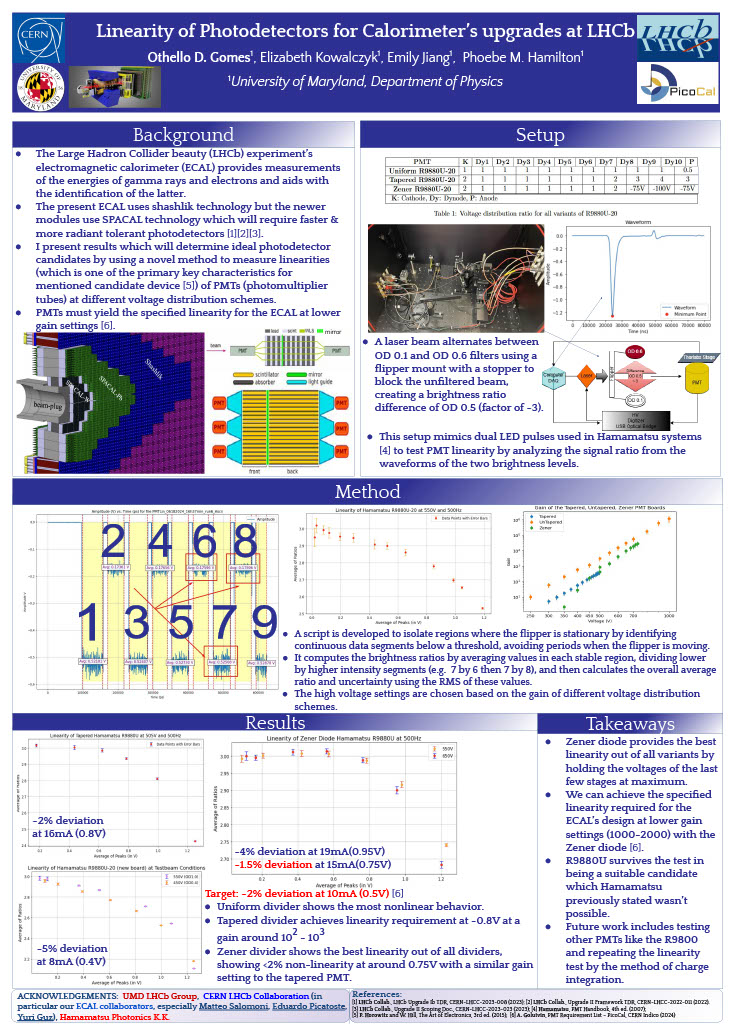
After the FCCee project, I was determined to pursue HEP research and consulted with LHCb faculty, Prof. Phoebe Hamilton regarding my interest. I thus began working on the R&D of the ECAL's Upgrade II, doing linearity tests for multianode and single anode PMTs that will be installed during Long Shutdown 3 (LS3) and subsequently LS4. I tested different characteristics (such as amplitude and charge) of the PMTs to determine this but setup wise, the process was simply executed by flipping between two OD filters in the blackbox.
Comparison of Simulation Tools for Precise Two-Photon Background EWK Z Boson Measurements at the FCC - MIT
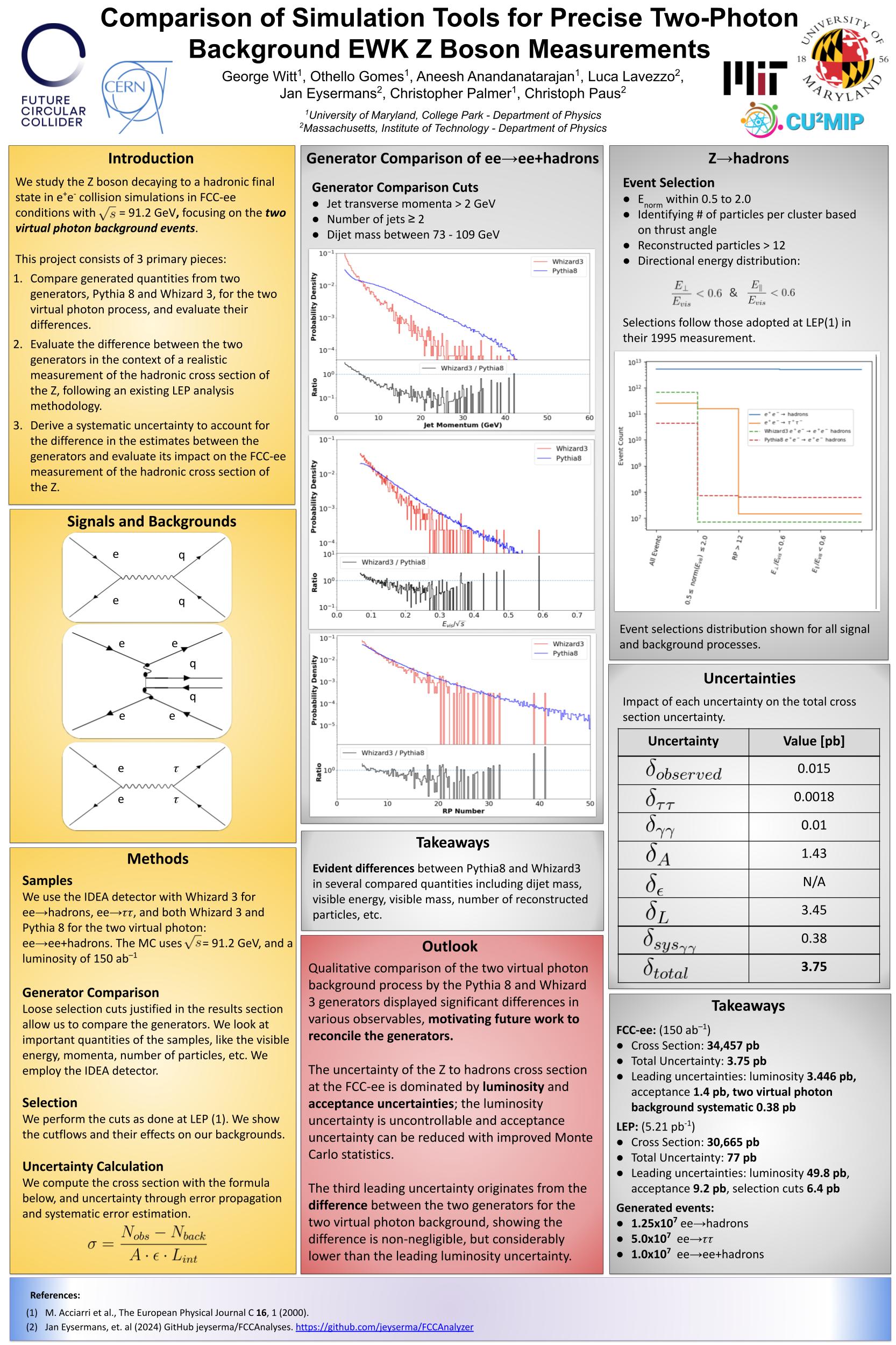
This project was for a Particle Physics class that I took with Prof. Christopher Palmer in the Spring of 2024 and the projects done were jointly between UMD and MIT. There were 3 undergraduate students in my group (including myself, Aneesh Anandanatarajan, and George Witt); we were being advised by graduate student, Luca Lavezzo, post-doctoral scholar, Dr. Jan Eysermans, and faculty member, Prof. Christoph Paus. At UMD, we were being advised by Dr. Chris Palmer. We worked on simulating the two photon virtual background from Z Boson collision event via Monte Carlo generators (Whizard3 and Pythia8). We analyzed various kinematic properties by plotting the invariant mass, pseudorapidity, luminosity, four-vector momentum, and cuts of each segment of the event.
Curing the Quantum Sign Problem via phase transitions: QuICS - UMD
I reconvened with my GRAD-MAP Winter Workshop mentor to work on my current research project under a Seed Grant via Prof. Jacob Bringewatt (then graduate student - I was co-advised by Dr. Dominik Hangleiter) through the Joint Center for Quantum Information and Computer Science (QuICS). I interpreted the mappings of computational complexity class 3SAT and MAX2SAT in NP-Complete, and NP-Hard to two-local Hamiltonians that have a quantum numerical sign problem. Depending on how bad the sign problem is, next steps involve mitigating or curing it as well as finding a physical interpretation of the Lattice Ising model mapping that is within a similar computational complexity class.
Explaining the Re-inflation of Hot Jupiters Orbiting Post-Main Sequence Stars: GRAD-MAP Summer Scholars 2022 - UMD
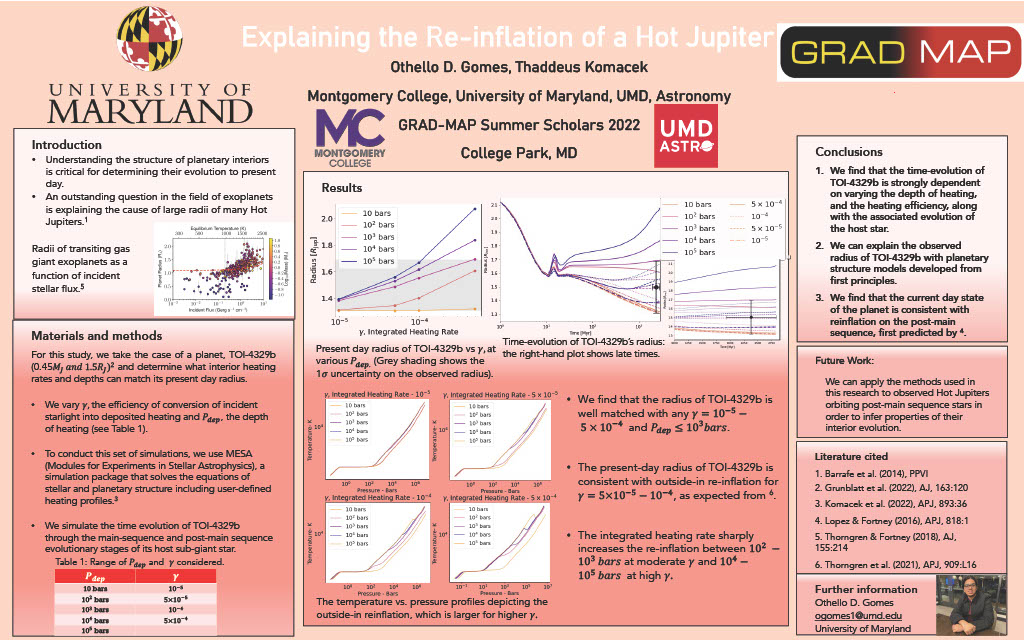
For the summer of 2022, I continued with GRAD-MAP into their Summer Scholars REU program, where I was paired to work under an Astronomy faculty mentor (Prof. Thaddeus Komacek) on figuring out the re-inflation of Hot Jupiters orbiting post-main sequence stars. During my time with this program, I learned how to read, analyze, and present research papers and how to do active data analysis and figure out results from simulations based on the research project I was undertaking.